Put the Price in the Video
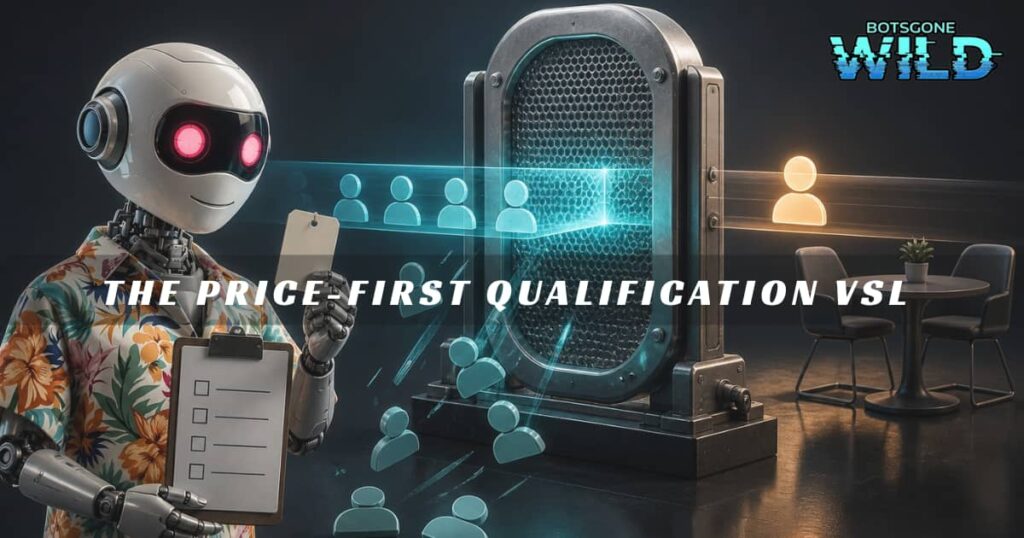
The Price-First Qualification VSL
A qualification-first VSL for expensive B2B offers.

Hey humans!
Most sales videos are built to keep everyone watching.
That sounds sensible until you sell something expensive. Then the real job is different. You want the right buyer to understand the offer quickly, see the price without a weird reveal at the end, and decide whether a sales conversation is worth having.
That is the system in this Deep Dive: a short, price-first VSL that acts as both a sales asset and a filter for the sales team.

Today’s Playbook
A Video Sales Letter is not automatically a funnel. It becomes a funnel when the video moves a buyer through the decisions they need to make before they book a call.
The raw framework has seven parts:
- State what you do in one sentence.
- Explain why your company can help, using real proof.
- Address the reasons someone might buy.
- Present the offer and its actual price.
- Answer the objections that come up on sales calls.
- Say who the offer is for and who it is not for.
- Give one clear next step.
The important mechanism is not “make a long video.” It is decision order.
The buyer first needs to know whether the problem is relevant. Then whether you are credible. Then what they are actually buying. Then whether the price and fit make sense. Only after that should the application or calendar link appear.
For high-ticket B2B, a two-to-fifteen-minute video can explain a narrow offer without forcing a busy operator through a feature parade. Wistia’s 2025 report treats landing pages and video galleries as meaningful engagement surfaces. Use that as a reason to test the asset, not as a promised conversion rate. Wistia’s State of Video report
The price is the filter.
This does not mean every B2B offer must publish a fixed price. It means that if the offer is standardized enough to have a real price, hiding it until the call creates an avoidable mismatch. If the price genuinely depends on scope, say what determines it and give a credible range or starting point.
The fake value stack is the other trap. Inflating a pile of imaginary bonuses and comparing it with a made-up reference price may create temporary excitement, but it makes a serious buyer wonder what else is padded. The FTC’s advertising guidance is blunt on the baseline: claims must be truthful, non-deceptive, and evidence-based. Its pricing guides also warn against fictitious former prices used to manufacture a discount. FTC advertising guidance and FTC guidance on former-price comparisons
The measurement mistake is lower in the funnel. Teams celebrate plays, form fills, or booked calls while ignoring fit. Google Ads separates qualified leads from converted leads, and that distinction belongs in your VSL report. Google’s guidance on qualified and converted leads
Your VSL Isn’t the Problem—Your Lead-Gen Path Might Be
Your VSL may create interest. Your lead-gen path decides what happens next.
Scale on Steroids audits the handoff from traffic to qualified B2B leads and booked calls, then finds where good interest turns into weak pipeline.
Start with the free growth-leak audit- ScaleOnSteroids
The Deploy
Use this outline for one offer. Keep it on a single page while you write.
1. The one-sentence promise
“We help [specific buyer] achieve [specific business outcome] through [the mechanism you actually deliver].”
If you need three sentences to explain it, the VSL is not ready.
2. The proof checkpoint
Use two or three proof points that match the buyer. A before-and-after number is useful. So is a concrete process, a recognizable constraint, or a short customer example. Do not borrow proof from a different audience just because it looks impressive.
3. The buying motives
Write the obvious motive first, then the quieter ones. A founder may want more pipeline, but also fewer handoffs, less dependence on one channel, or a sales team that stops chasing bad opportunities.
4. The offer and price
Name what is included, what is not included, and the exact price if the scope is fixed. If it varies, state the starting point and the variables. No invented “value” numbers.
5. The objection pass
Pull five objections from actual sales calls. Answer them plainly. “Will this work for a company our size?” is better than a generic “we have helped businesses like yours.”
6. The fit filter
Give three signs someone is a fit and three signs they are not. This increases trust because the buyer can self-select before entering the calendar.
7. The CTA
Use one action. Apply, request the audit, or book the call. Do not put three competing buttons below a video that was supposed to simplify the decision.
Then instrument the funnel:
traffic source -> video started -> 25% watched -> 75% watched -> application -> qualified -> booked -> closed
Your first pass metric is not video completion. It is qualified applications divided by total applications. Your second is booked calls that show up and fit the stated criteria. Your third is closed revenue by source.
Run the first version for two weeks. Change one thing at a time: the promise, proof, price placement, fit filter, or CTA.

🎯 NEXT STEPS
- Pick one offer and write the one-sentence promise, price, and fit criteria before opening a camera.
- Pull five real objections from sales calls and answer them in plain language.
- Track qualified applications and closed revenue separately from video plays and raw form fills.
Stay weird,
Vaibhav
P.S. The next version of your VSL should make at least one bad-fit buyer leave before they reach your calendar.