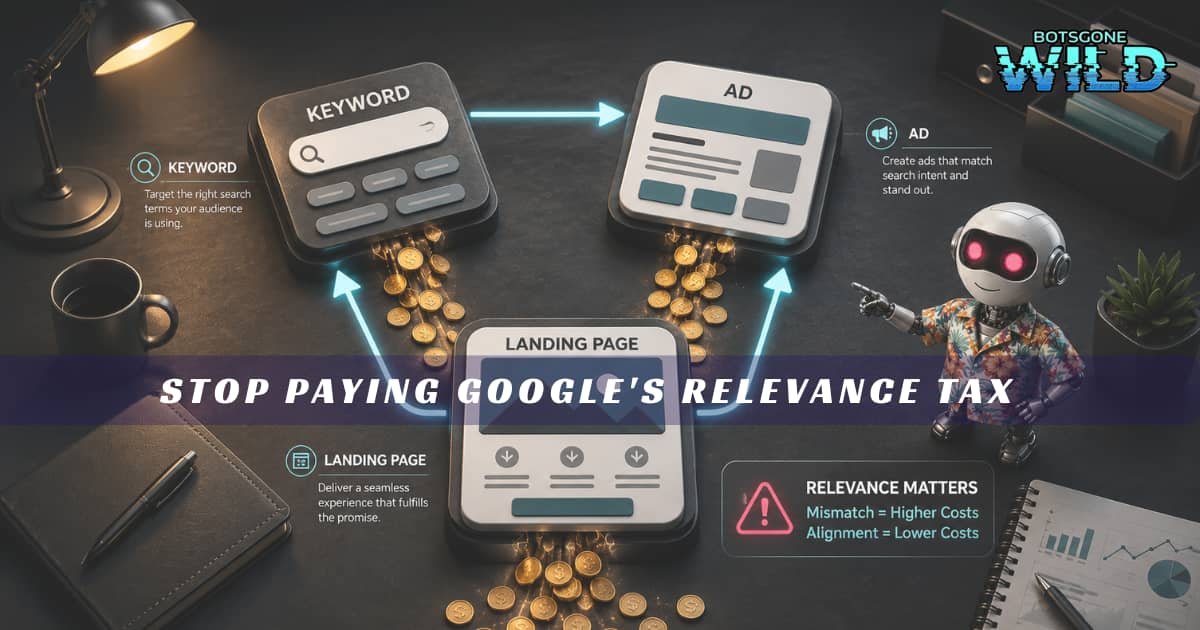
Stop Paying the Relevance Tax
The paid-search loop that lines up keyword, ad, and landing page before Google taxes the mismatch.

Hey humans!
Vaibhav here. Today’s issue is about a very boring paid-search metric that quietly decides whether your clicks are cheap or stupidly expensive.
Quality Score.
I know. The name sounds like something a dashboard invented to make you feel small.
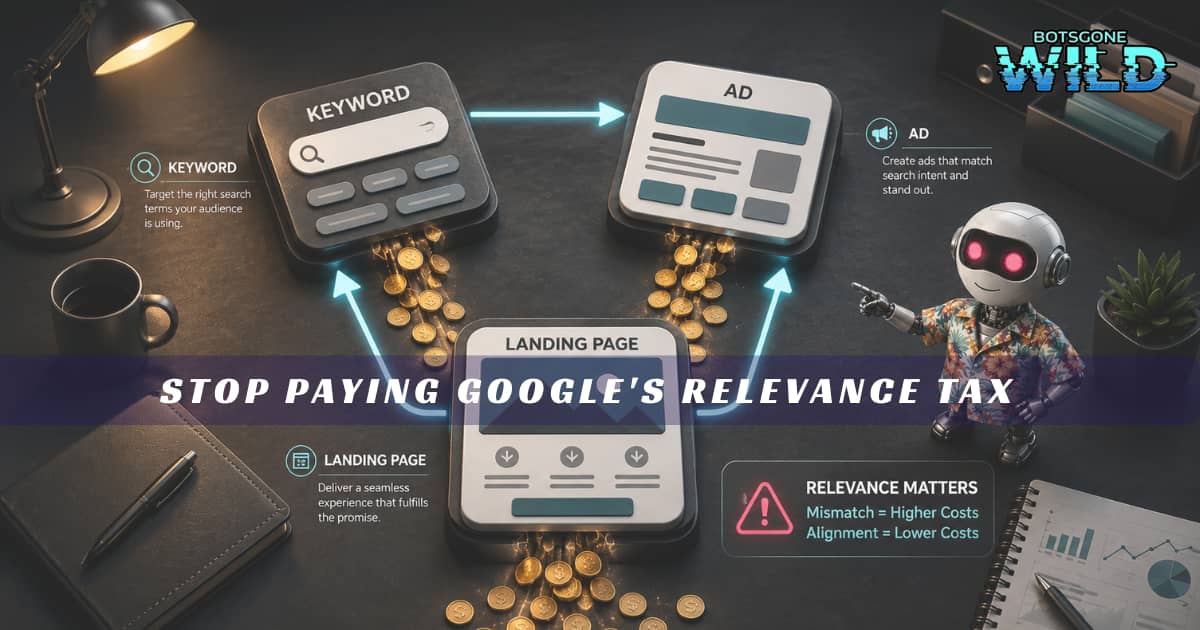
But the operator version is simple: if your keyword, ad, and landing page do not match, Google makes you pay for the confusion.
Chuck called it “a tax on being vague.” Annoying little robot. Correct again.
Today’s Playbook
(4 min read)
Quickies:
- SEO tools do not have Google’s internal metrics
- Follow-up automation starts before the sequence
🛠️ This Week’s AI Arsenal
- Flick
- EmailFunnelAI
📋 Mini-Playbook: The Message-Match Quality Score Loop
[FOR YOUR TEAM]
Give this to whoever is touching paid search, landing pages, or nurture. Before you spend more, make the promise match.

⚡ QUICKIES
➡️ SEO Tools Still Do Not See the Whole Machine
Search Engine Journal covered Google’s reminder that third-party SEO tools and vendors do not have access to Google’s internal metrics.
Useful translation: dashboards can help you spot patterns, but they cannot replace judgment.
If a tool says your AI visibility, domain score, or “GEO readiness” is up, ask the boring operator question: did qualified traffic, leads, or assisted revenue move?
The metric is not the machine.
➡️ Follow-Up Is Three Layers, Not One Sequence
The ScaleOnSteroids field note on small-team follow-up makes the point most automation pitches skip: a sequence only works after capture and scoring are clean.
Capture every lead in one place. Score it by fit and intent. Then sequence.
Most teams jump to email three and wonder why the system feels haunted.
Before you buy another automation tool, audit the front of the pipe. Are leads tagged by source, fit, and date? If not, your follow-up is just organized guessing.

You’re Not Missing Opportunities. You’re Leaking Them.
If your ads, SEO, or follow-up all feel busy but nothing compounds, you probably do not need more output.
You need to find the leak.
Find your growth leak – ScaleOnSteroids
🛠️ THIS WEEK’S AI ARSENAL
Flick
Swipe-style inbox triage for email decisions. The useful angle is not “fun inbox.” It is decision speed. Use it for founder inbox cleanup, sponsor leads, warm replies, or any folder where messages die because opening Gmail feels like tax season.
AI-assisted lifecycle funnel builder with briefs, connected sequences, triggers, and variants. Do not use it to generate generic drip sludge. Use it to map one offer, one audience, one next action, then create the first draft of the sequence around that strategy.

📋 Mini-Playbook: The Message-Match Quality Score Loop
Paid search gets expensive when your campaign makes Google do translation work.
The user searches one thing. Your ad says a slightly different thing. Your landing page says something broader again.
That mismatch hurts relevance, conversion rate, and Quality Score. You feel it as higher CPC, lower conversion, and that lovely sensation of setting money on fire in a tab called “Campaigns.”
The fix is not magic. It is message match.
Step 1: Pick One Ad Group That Is Leaking
Do not audit the whole account today.
Pick one ad group with spend, low conversion rate, or suspicious CPC.
Pull three things into a doc: the highest-spend keywords, the live ad copy, and the landing page headline plus first screen.
If those three do not feel like they belong to the same conversation, you found the leak.
Step 2: Write the Search Intent in Plain English
For each main keyword, finish this sentence:
“The searcher is trying to…”
Example: someone searching “crm follow up automation” is not looking for “business growth solutions.” They want to stop leads from going cold without hiring another person.
That sentence becomes your campaign brief.
Step 3: Mirror the Keyword Without Becoming a Robot
Your ad should include the core search language in the headline or description.
Your URL path can reinforce it too.
Your landing page headline should make the same promise in human language.
Bad match: keyword is “google ads quality score,” ad says “scale your marketing,” landing page says “full service growth agency.”
Better match: keyword is “google ads quality score,” ad says “Fix Low Quality Score,” landing page says “Find the Message-Match Leak in Your Google Ads.”
Same intent. Cleaner path.
Step 4: Check the Landing Page for Proof and Next Action
Message match gets the click to trust the page. Proof and next action make the click do something.
Add one proof element above the fold: example result, audit screenshot, testimonial, before-after, or specific mechanism.
Then make the next action obvious.
One CTA. One offer. One path.
Step 5: Run the 7-Day Relevance Test
Change one ad group, not the whole account.
Track Quality Score, expected CTR, landing page experience, CPC, conversion rate, and cost per lead for seven days.
The pass/fail is not “did the score become 10?”
The pass/fail is: did message match lower waste or improve conversion enough to keep testing?
If yes, roll the same audit across the next ad group.
If no, your leak may be offer, page speed, audience, or conversion tracking. Clyde would like me to say: please check tracking before making a spreadsheet cry.

🎯 NEXT STEPS
- Pick one paid-search ad group with spend.
- Copy the keyword, ad, and landing page headline into one doc.
- Write the search intent in plain English.
- Rewrite the ad and page headline so they make the same promise.
- Run the 7-day relevance test before raising budget.
Stay weird,
Vaibhav
P.S. Next issue, I want to look at the Machine side: the part where a lead arrives, nobody follows up cleanly, and everyone pretends the traffic was the problem.